
Views: 0 Author: Site Editor Publish Time: 2026-04-21 Origin: Site


Indexing plungers are essential components in many mechanical systems, offering an easy and reliable method to lock, position, and adjust parts in place. These small yet powerful devices are commonly used in industrial applications such as machinery, fixtures, and automation systems. They help maintain precise positioning by allowing components to be securely locked or unlocked without the need for additional tools, offering simplicity and efficiency in various operational environments.
The role of indexing plungers goes beyond mere position holding—they provide repeatability, accuracy, and reliability, which are crucial for industries that require fine-tuned adjustments. Whether for locking a part temporarily or positioning a fixture for precision work, indexing plungers help achieve smooth transitions and precise movements in manufacturing, assembly, and equipment design.
An indexing plunger is a mechanical locking and positioning element. It typically consists of a threaded body, a spring-loaded pin, and a knob or pull ring for manual operation. The pin extends into a mating hole or notch to hold a part in place. When the user pulls the knob, the pin retracts, allowing the part to move freely. Once released, the spring pushes the pin back out so it can engage again in another defined position.
This simple action can be repeated for precise control over machinery or fixtures that require frequent repositioning. While the operation may appear basic, the value lies in its ability to offer a secure hold without any additional equipment.
Indexing plungers are used primarily to position and lock machine parts, tools, or fixtures. They are especially useful in manual systems where frequent adjustments are necessary. Once engaged, the plunger pin holds parts in a fixed position to prevent unwanted movement. When the adjustment is made, the pin can be released and repositioned, enabling easy control over machinery or components.
In most applications, the primary function is to allow for accurate and repeatable positioning. Whether it’s for jigs, fixtures, workpieces, or other parts, the indexing plunger ensures that the system returns to the desired position every time, reducing human error and increasing operational efficiency.
Fixtures and Workholding
In industrial manufacturing, precision workholding is critical. Indexing plungers provide secure positioning in fixtures, reducing setup time while ensuring parts are held firmly during machining or assembly operations. This is particularly useful in industries such as automotive, aerospace, and electronics, where accurate assembly and testing are crucial.
Tool and Die Adjustment
In tool-making and die-casting, indexing plungers are often used for quick and secure adjustment. They enable tool holders and workpieces to be set to precise positions, ensuring that each part is consistently manufactured to exact specifications.
Robotics and Automation
Indexing plungers play a significant role in robotics and automated systems, particularly in positioning actuators or parts. They provide an efficient means to lock parts in place for assembly, handling, and storage. Robots rely on precision, and indexing plungers make it possible to achieve accuracy without manual intervention.
Custom Fixtures
Indexing plungers are widely used in custom tooling setups. In industries where each project requires a different configuration or adjustment, indexing plungers provide the flexibility to quickly reposition parts and components without the need for tools or complex machinery changes.
Conveyor Systems
In some automated conveyor systems, indexing plungers are used to lock parts or containers in place as they move through assembly lines or inspection areas. This makes it easier to inspect parts at regular intervals or allow operators to make adjustments as required.
The working mechanism of indexing plungers is relatively simple but very effective. The core component is the spring-loaded pin that is manually activated by pulling the knob or lever. As the pin retracts, it disengages from the hole or notch, allowing the part to move. Once the part has reached the desired position, the pin is released, and the spring mechanism pushes the pin back into place, securing the part. This action ensures that the part remains in position without the need for continuous adjustment or tools.
The design of indexing plungers often includes a variety of locking mechanisms, including both push-type and pull-type options. This flexibility allows operators to select the best option depending on the level of force required, the space available, and the specific needs of the application.
Simple Operation: The spring-loaded pin mechanism is easy to operate, providing a user-friendly solution for locking and positioning.
Durability: Made from durable materials like stainless steel or hardened alloys, indexing plungers are designed to withstand the wear and tear of industrial environments.
Repeatability: Indexing plungers offer high repeatability, ensuring that components return to the same position with each adjustment.
Cost-Effective: Given their simplicity, indexing plungers are an affordable solution for positioning and locking tasks, reducing costs in complex machinery systems.
Compact Design: Their compact size allows for use in tight spaces without compromising performance.
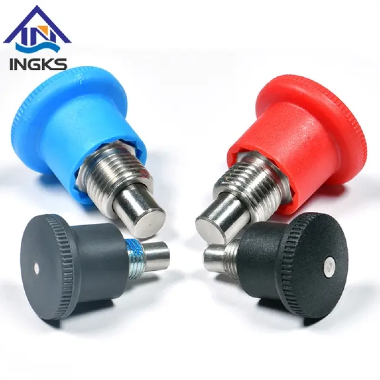
While selecting an indexing plunger, several factors must be taken into consideration to ensure optimal performance in the desired application:
Load and Force Requirements
Consider the amount of force that will be required to hold the part in place. Some applications require higher locking forces to secure larger parts, while others may need just a gentle hold. It's essential to choose a plunger that matches the expected load requirements.
Material and Durability
Indexing plungers come in a range of materials, including stainless steel, carbon steel, and plastic. The material should be selected based on the operating environment, such as exposure to corrosive substances, temperature fluctuations, or high-stress conditions.
Mounting Type
Different indexing plungers come with different mounting styles, including threaded or non-threaded options. Threaded types are often used for deeper insertion into components, while non-threaded versions may be suitable for less permanent installations.
Pin Size and Stroke
The size of the pin and its stroke (the distance it travels) will determine how much adjustment can be made. Consider the specific application and the precision required when choosing these factors.
Temperature and Environmental Conditions
Ensure the plunger selected is suitable for the operating temperature and environmental conditions. High temperatures, exposure to chemicals, or harsh environments may require specialized coatings or materials.
Feature | Standard Indexing Plunger | Heavy Duty Indexing Plunger | Pull Type Indexing Plunger |
Material | Stainless Steel | Hardened Steel | Stainless Steel |
Locking Mechanism | Push Button | Push Button | Pull Button |
Load Capacity (kg) | 20 | 100 | 50 |
Stroke (mm) | 10 | 20 | 15 |
Temperature Range (°C) | -20 to 80 | -40 to 150 | -20 to 80 |
Mounting Type | Threaded | Non-Threaded | Threaded |
In summary, indexing plungers are simple yet indispensable tools for ensuring precise positioning, secure locking, and repeatability in a wide variety of applications. Whether used in machinery, fixtures, or custom tooling, these compact devices provide cost-effective and reliable solutions for controlling parts during manufacturing, assembly, and automation processes. By selecting the appropriate indexing plunger based on your system's needs, you can ensure high performance, durability, and precision.
If you're looking for high-quality indexing plungers to enhance your mechanical systems, consider exploring the range of options offered by Wuxi Ingks Metal Parts Co., Ltd. Their extensive selection of industrial components is designed to meet the needs of diverse applications, ensuring that you find the right solution for your project.
Q: What is an indexing plunger?
A: An indexing plunger is a mechanical device used to lock, position, or adjust parts in place within machinery or fixtures. It typically consists of a spring-loaded pin that engages with a hole or notch to secure the part.
Q: How does an indexing plunger work?
A: The plunger pin retracts when manually activated, allowing movement. Once the desired position is reached, the pin is released, and the spring mechanism pushes the pin back to lock the part in place.
Q: Why choose indexing plungers over other positioning devices?
A: Indexing plungers offer ease of use, repeatability, and compact design, making them ideal for applications requiring frequent repositioning or locking without complex adjustments or additional tools.
Q: Can indexing plungers be used in automation systems?
A: Yes, indexing plungers are commonly used in robotics and automation for precise part positioning and locking during assembly, inspection, and other processes.


